
When we conduct evaluation in exhibitions, we sometimes hear from visitors that they want “more information.” More on the artist. More on the topic. More about an object. And this is great! It means people are curious, and something in the museum caught their interest enough to want to know more.
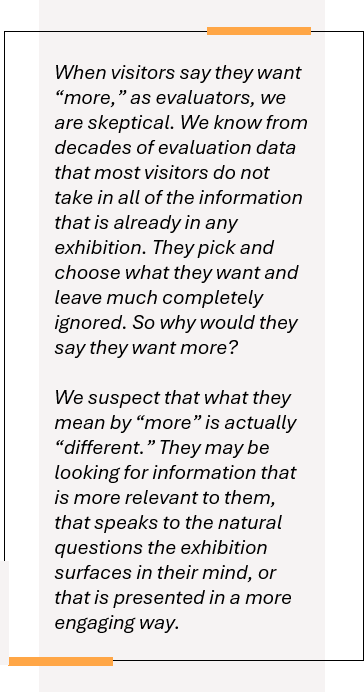
Museum staff, meanwhile, are usually sitting on more knowledge than any wall label can hold, and a desire to share as much as possible. This speaks to their unique expertise and genuine enthusiasm for sharing their knowledge.
Balancing this desire for “more information” with the very real limitations of gallery space, time, and museum fatigue, QR codes might seem like the perfect solution. In theory, QR codes can let visitors who want more information dive deeper, in the moment or after their visit. QR codes can also allow for museum staff to share extra information, resources, and other content that wasn’t able to make it into an exhibition.
But, are QR codes in exhibitions actually being used? And are they worth the time staff invested in creating them?
The answer is, probably not as much as the museum had hoped. The success of a QR code depends on many variables, like where the QR is placed, its labelling, and what type of information or resource it leads to.
But overall, based on data from seven exhibition evaluations we’ve conducted in the past five years that asked about QR codes, we know that QR code usage is low. In six out of seven evaluations, 8 percent or less of visitors reported using any QR code in the exhibition.
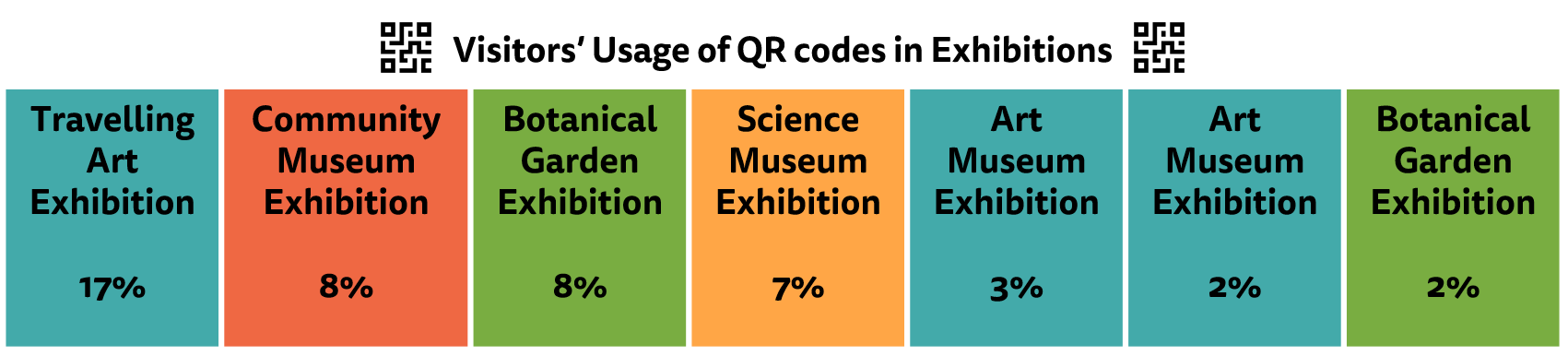
These studies spanned across various types of organizations (art, science, and community museums and botanical gardens) and resources (audio tours, extra information about artwork or objects, recipes, and activities). The highest QR code usage was in a travelling exhibition featuring Aboriginal artworks, where the exhibition’s wall labels highlighted the artists’ voices and stories, while the QR codes provided access to contextual information about the artworks.
Using QR codes in exhibitions can be at odds with the reasons visitors come to museums in the first place.
We find over and over again that people visit museums and cultural organizations for a few key reasons: to see the “real thing” (e.g., artwork, objects, living collections, architecture); to be amazed by or immersed in a space unlike anywhere else; and to spend time with friends and family.
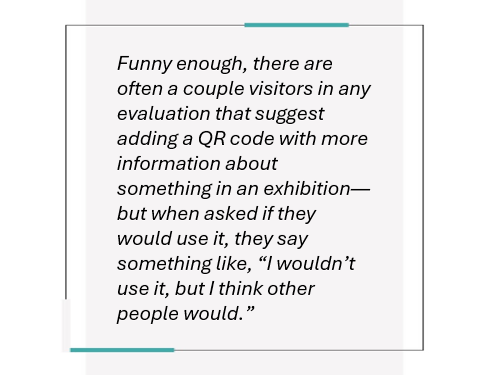
QR codes do not accomplish any of these prime motivators; in fact they tend to detract from these goals. Our evaluations also point to specific reasons visitors, even those who suggested adding QR codes, ultimately choose not to engage with them.
Many people go to museums to take a break from their phones. For example, in one study we found that older participants were not interested but thought it might be more interesting for younger, tech-oriented visitors, while younger participants said they wanted to get off their phones and enjoy “being present.”
The content or resource format is not easy to use in the exhibition. For example, if a QR code links to a long video or text-heavy website, visitors may not want to stand in the exhibition watching a video or reading on their phone and taking away the limited time they’ve set aside to visit the museum in-person.
The label does not clearly communicate where the QR code leads to. We’ve heard across studies that another reason people will choose not to scan a QR code is because they don’t know where it will take them and what information or experience it will offer. That ambiguity leads them to skip it rather than engage.
This is not to say that QR codes are never the answer. They definitely have a time and place, and you may have seen some great uses of QR codes in exhibitions. But it is a reminder to think carefully about whether they are the right fit for the content you want to share and to carefully consider the “lift” in terms of staff capacity to create resources that will be accessed primarily via a QR code in an exhibition.