
Earlier this year, I had the realization that I can normally identify a good facilitated conversation just by looking at a transcript, without even reading it. To my eyes, a good conversation means the facilitator’s contributions appear sparsely while individual participants’ contributions appear abundantly in varying degrees and orders, but consistently throughout the conversation.
But what sets up these conditions? That is what I dive into with this second post.
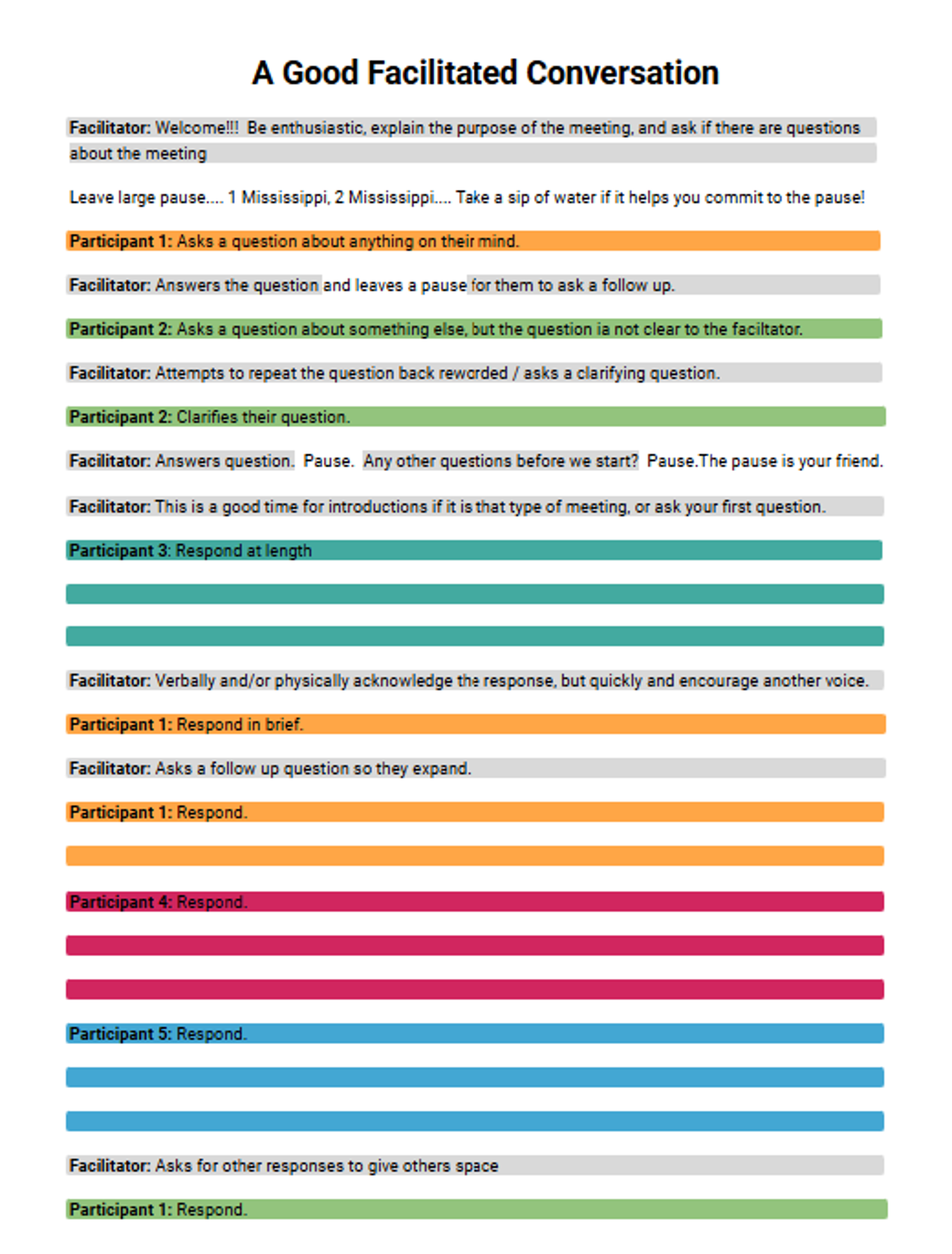
This color-coded transcript describes the facilitator’s contributions (in gray) contrasted with the other speakers’ colors.
Tips and Strategies for Facilitators
Since facilitated conversations are almost always time bound, the facilitator needs to make the most of the 60 or 90 minutes with a group while giving all of your participants space to show their colors! These are the critical elements:
1. Be welcoming!
While welcoming is traditionally emphasized at the beginning of the convening, a good facilitator applies welcoming to the entirety of a conversation. To me, welcoming is about attentiveness and caring. If you are meeting virtually, notice when someone unmutes and invite them to speak or apologize if you speak over someone. If meeting in-person, consider your own body language and that of others. For example, as the facilitator, you want to ensure you physically direct your body and eyes to everyone in the room.
2. Pause.
A lot of people struggle with silence. This applies for both facilitators AND participants. As a facilitator, don’t shy from leaving a ... 1 Mississippi … 2 Mississippi ... pause after a comment. I find sometimes the most insightful comments come after such pauses. And if you as the facilitator are someone who struggles with the urge to fill the air, take a sip of water if it helps you commit to the pause!
3. Encourage Questions
A conversation should be a back and forth. As the facilitator, you are coming with your questions, but invite participants to ask questions too. Particularly as you begin the conversation, you want to allow participants to ask questions about the purpose of the meeting and its goal. Throughout the conversation, you may have clarifying questions of your own or want to hear from participants about their questions or wonderings.
Is That It?
Alas, this is of course a simplification. In her book The Art of Gathering: How We Meet and Why It Matters, Priya Parker notes that 90% of what makes a gathering like a facilitated conversation successful is put in place beforehand. While the facilitator’s actions and comments during a conversation play a huge role in the success of a conversation, there are other considerations that I don’t cover here, such as inviting the “right” participants and preparing the setting–be it an in-person meeting with food and nametags or a virtual meeting in the evening.
For more tips and strategies on facilitating conversation, see:
Cathy’s takeaways from The Art of Gathering, which includes some tips for that pre-gathering work and much more!
Ebony’s reflection on how teaching skills have parlayed over to interview skills, including scaffolding the conversation.
Emily’s reflection on interviewing as essentially being the pursuit of curiosity.