Any time you are planning for evaluation, one of the first questions that might arise is, “How many people do we need to hear from?” But I'd argue an even more important question is who you need to hear from. Collecting feedback is great, but I could collect 1,000 surveys and learn very little if the people I surveyed were not part of my target audience. Data collection is only useful if you are talking to the right people—the people whose knowledge, experiences, and perspectives are going to help you answer your study questions.
This is the foundation of your sampling plan: an explicit description of who you plan to talk to and how you will reach them. If you are getting ready to collect data at your museum, here are some questions and considerations to keep in mind as you think through a sampling plan.
Who holds the knowledge you are interested in?
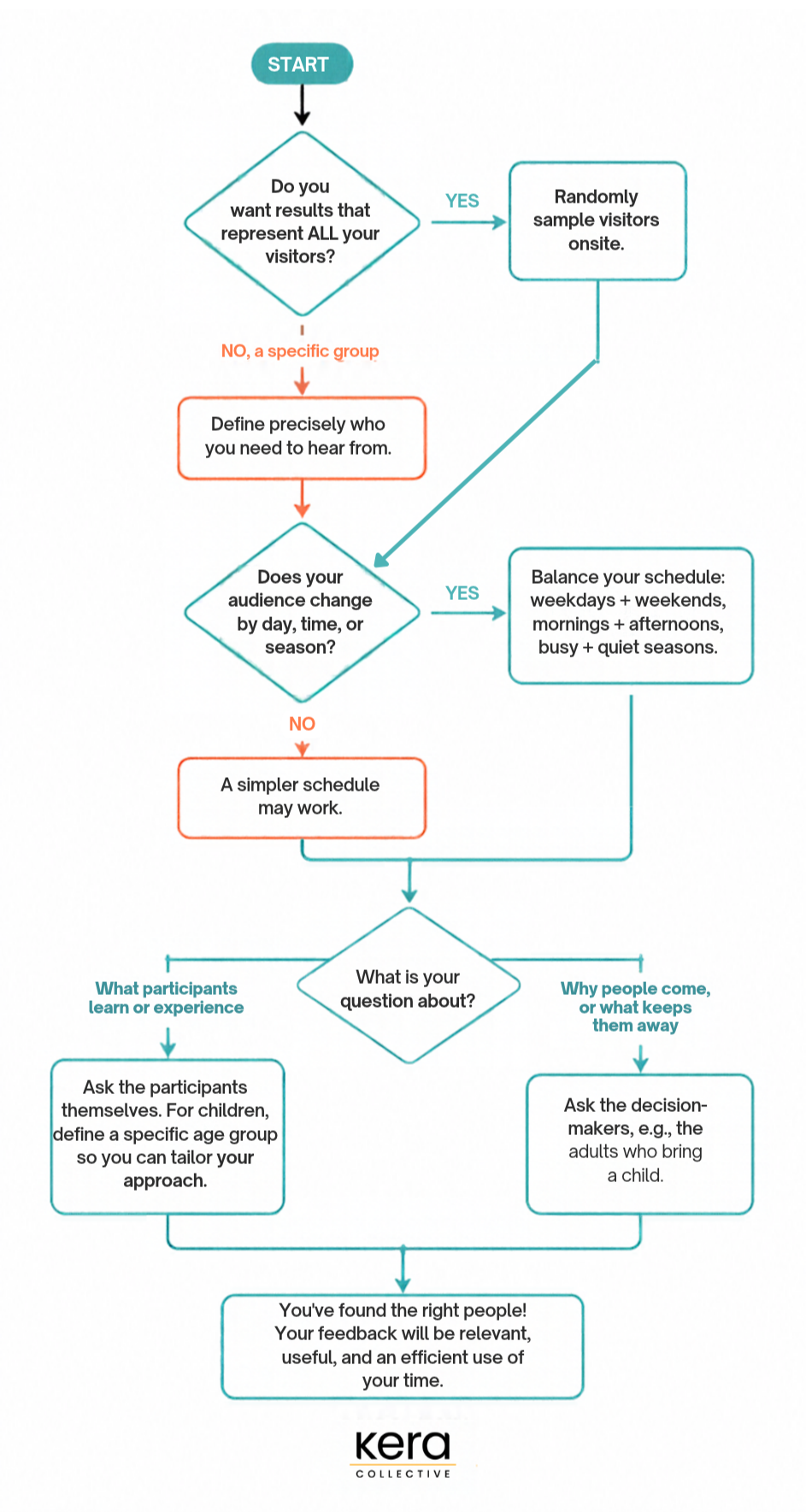
Start with your study objectives: who can really answer the questions you want answered? For example, maybe you want results about the onsite museum experience that you can generalize to all of your visitors. In this case, randomly sampling visitors at your museum can give you a snapshot of your general audience. But that audience may change by day, time, or season. To get the full picture, you might need to collect data on weekdays and weekends, in mornings and afternoons, and potentially across seasons (e.g., a four-season study, or one that covers both busy and quiet seasons). A well-balanced data collection schedule that accounts for these factors is key to an accurate look at your general audience.
Alternatively, maybe you want to learn about families' expectations and experiences in your public programs. Here, you'll need to define more precisely who you want to hear from. If you are interested in learning outcomes for a children's program, it may be important to get feedback directly from children (and to define a specific age group, so you can tailor your data collection approach). But if your questions focus on motivations and barriers to attending, a child likely can't answer them. In that case, it's more useful to focus on the adults who decide to bring a child to the program.
We made a flow chart on the right that highlights some decision-making junctures for most (but not all!) sampling scenarios that can happen in museums —>
Who might be missing?
Just as important as knowing who you want to talk to is considering who might be missing from your sample. We always collect refusal data during data collection—observable characteristics of the visitors who declined to participate in a study, like age, gender, and visit group. We can compare the characteristics of those who declined to participate to those who agreed to see if there are notable differences. This can give us clues as to whether we really captured our intended participants.
For example, we sometimes find that during onsite data collection, visit groups with young children are more likely to decline than adult-only groups or visitors who come alone. This makes sense—it can be hard to manage young children and thoughtfully answer questions from a data collector at the same time! If perspectives from visit groups with young children are important to answering our study questions, we might need strategies to encourage their participation, such as a tailored recruitment approach or a method that makes participating easier for this group.
While the age-old question of "how many is enough?" is an important one, taking the time to clearly identify the “right” people is essential. Depending on your goals, you might need to talk to just a handful of the “right” people to answer your questions. In other cases, you might still need feedback from a larger sample to get the answers you need (and to have high confidence in those results). Either way, a good sampling plan keeps your data collection focused on relevant, useful feedback and makes the most efficient use of your time, effort, and budget.